◇ Click here for Japanese.
Kyutech has four international courses for master's and doctoral students.
- Space Engineering International Course (SEIC)
- Innovative AI/Robotics Technologies Course (iART)
- Global Advanced Assistive Robotics (GAAR)
- Global Education in Green Energy, Green Environment, and Green Economy for Global Innovation Leaders Course (GE4)
- Leading Southeast Asia Cooperative Program for the Development of Advanced Medical and Diagnostic Technologies (DAMD)
Space Engineering International Course (SEIC)
This graduate program (taught in English) offers: (1) a diverse series of lectures on space engineering, (2) project-based learning on space development in collaboration with Japanese students, (3) and on-the-job training on space environment testing (testing of nano-satellites using advanced test equipment).
This program provides hands-on experience needed to build capabilities in basic space technology, especially infrastructure-building through testing of nano-satellites to further worldwide nano-satellite development efforts. Through this program, Kyutech answers the call from UNOOSA (United Nations Office for Outer Space Affairs) for long-time educational opportunities for capacity building of basic space technologies. In addition, SEIC contributes to the promotion of the peaceful and innovative use of outer space through the participation of emerging growth countries.
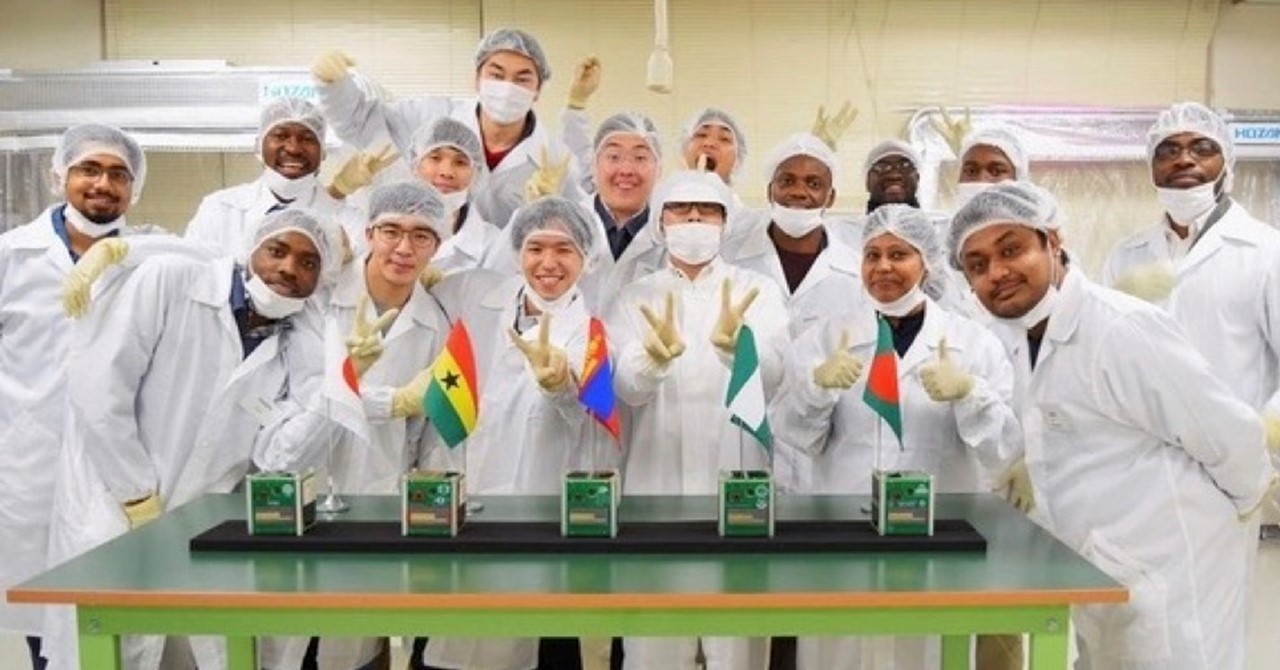
BIRDS1 group photo
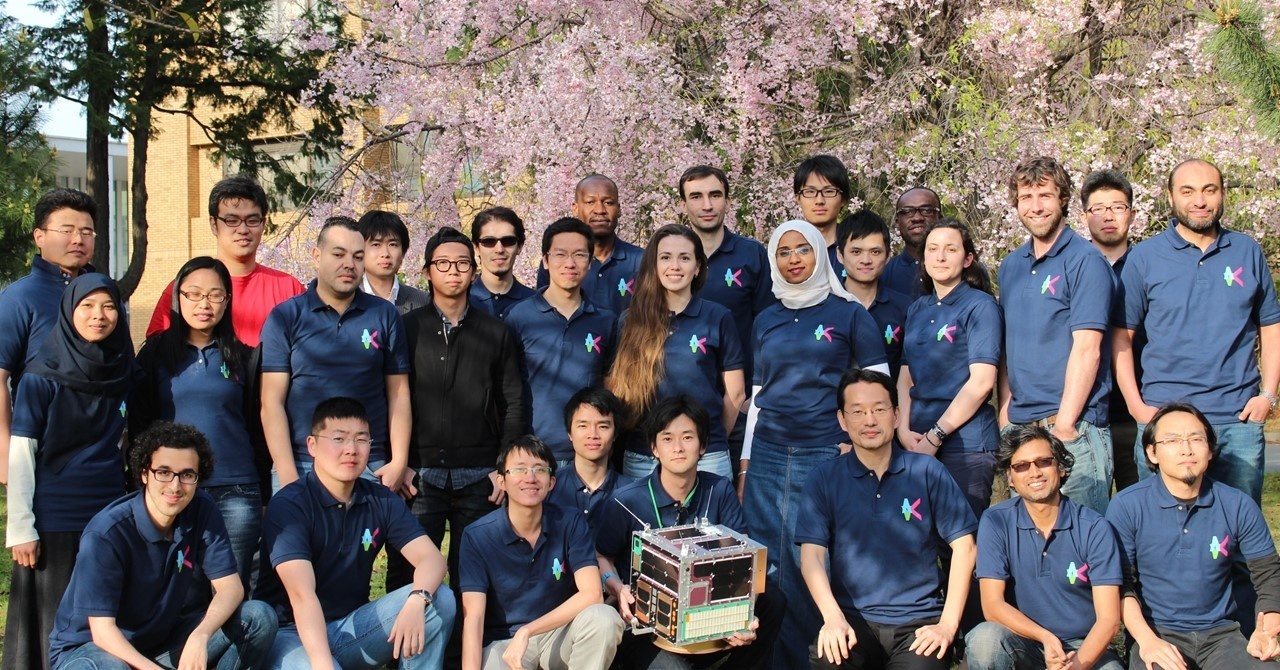
HORYU4 group photo
Innovative AI/Robotics Technologies Course (iART)
We aspire to invest in training and development of diversity with harmony that is a typical word through R&D education program in international exposure for the new generation of professional engineers. This program, Innovative AI/Robotics Technologies course (iART) easily will access international opportunities for the new generation, furthermore, offers Advanced Practices and Exercises, AI, Robotics, and robot-related classes to be a specialist to survive in a global race, and to acquire a wide range of advanced technologies. And then, it needs to enhance the education, research and so on of a diverse student to nurture specialists in artificial intelligence in the next-generation.
iART program aims to study and develop autonomous robots & system, data science and so on that use robotics and artificial intelligence to creatively improve the production and efficiency of robots.
● Advanced Practices and Exercises In Collaboration with Japanese students for skills on industrial AI/Robotics including data science, AR, and human-robot interface etc..
● AI, Robotics, and robot-related classes

Diverse Students in iART Program

Tomato Team for Harvesting Tomato Robot Project

Beach clean-up robot Project
Global Advanced Assistive Robotics (GAAR)
Innovative technological advances have been involving insight of multiple fields. There is a need for engineers who have advanced specializations and comprehensive knowledge of interdisciplinary engineering.
Global AAR (Advanced Assistive Robotics) Course is to learn advanced robotics emphasizing the aspect of assistive technology, and to foster highly skilled personnel who will gain practical ability as leaders to support next-generation technology, mastering their special fields, understanding the peripheral technology, and leading research and development teams.
The course will include the design and implementation of intelligent systems that could provide:
●Solutions to industry and medical welfare
●Intelligent systems that enable
・Increase in productivity and safety
・Decrease in labor load and patient pain
・Assist in motor skill learning and rehabilitation
●Multidisciplinary
・Robotics, Machine learning, Brain science, Psychology, and so on


Global Education in Green Energy, Green Environment, and Green Economy for Global Innovation Leaders Course (GE4)
The GE4(GE Quad) course nurtures global innovation leaders who will guide society towards sustainability by integrating environmental and economic perspectives with cyclical technologies for the creation, conversion, utilisation and regeneration of energy. The course aims to develop professionals who can bridge the gap between science and technology and societal implementation, creating new value within the ASEAN region where energy, environmental and economic challenges are advancing simultaneously. Starting in 2026, this course has been selected for the Ministry of Education, Culture, Sports, Science and Technology's “Special Program for Priority Placement of Government-sponsored International Students”, and it has established an international education system in which international and Japanese students can study and collaborate together. The Master's programme can be completed entirely in English and is designed to enhance globally applicable professional skills. During the GE4 seminar, faculty members from partner universities in Japan and abroad, as well as industry experts, share insights on the latest trends in carbon neutrality and green energy, equipping students with the practical knowledge needed to address social issues. Additionally, through international PBL (problem-based learning), students address issues overseas and develop international collaboration skills. Furthermore, entrepreneurship education fosters the ability to think and act with a view to the social implementation of advanced technologies.

Activities at UPM Business School

The collaborative learning program (International PBL) with UPM Business School
Leading Southeast Asia Cooperative Program for the Development of Advanced Medical and Diagnostic Technologies (DAMD)
The Leading Southeast Asia Cooperative Program for the Development of Advanced Medical and Diagnostic Technologies (DAMD Program) is designed to foster innovative leaders in the fields of healthcare and welfare. The program is offered as part of the educational and research activities of the Graduate School of Life Science and Systems Engineering. The DAMD Program provides an English-based international co-learning opportunity for students from Southeast Asian countries and Japan to acquire advanced engineering expertise together. Its educational and research areas cover a wide range of topics, including the development of new materials for wound healing, the creation of diagnostic devices for disease detection, the design of innovative drug delivery technologies, and the development of welfare systems that support patients, people with disabilities, and older adults. Through special courses such as seminars on cutting-edge research led by faculty members and researchers from both within and outside the university, as well as practice-oriented classes that promote research discussions and the creation of collaborative research themes in an international learning environment, the program aims to nurture global engineers who can contribute to the realization of a sustainable and inclusive society.